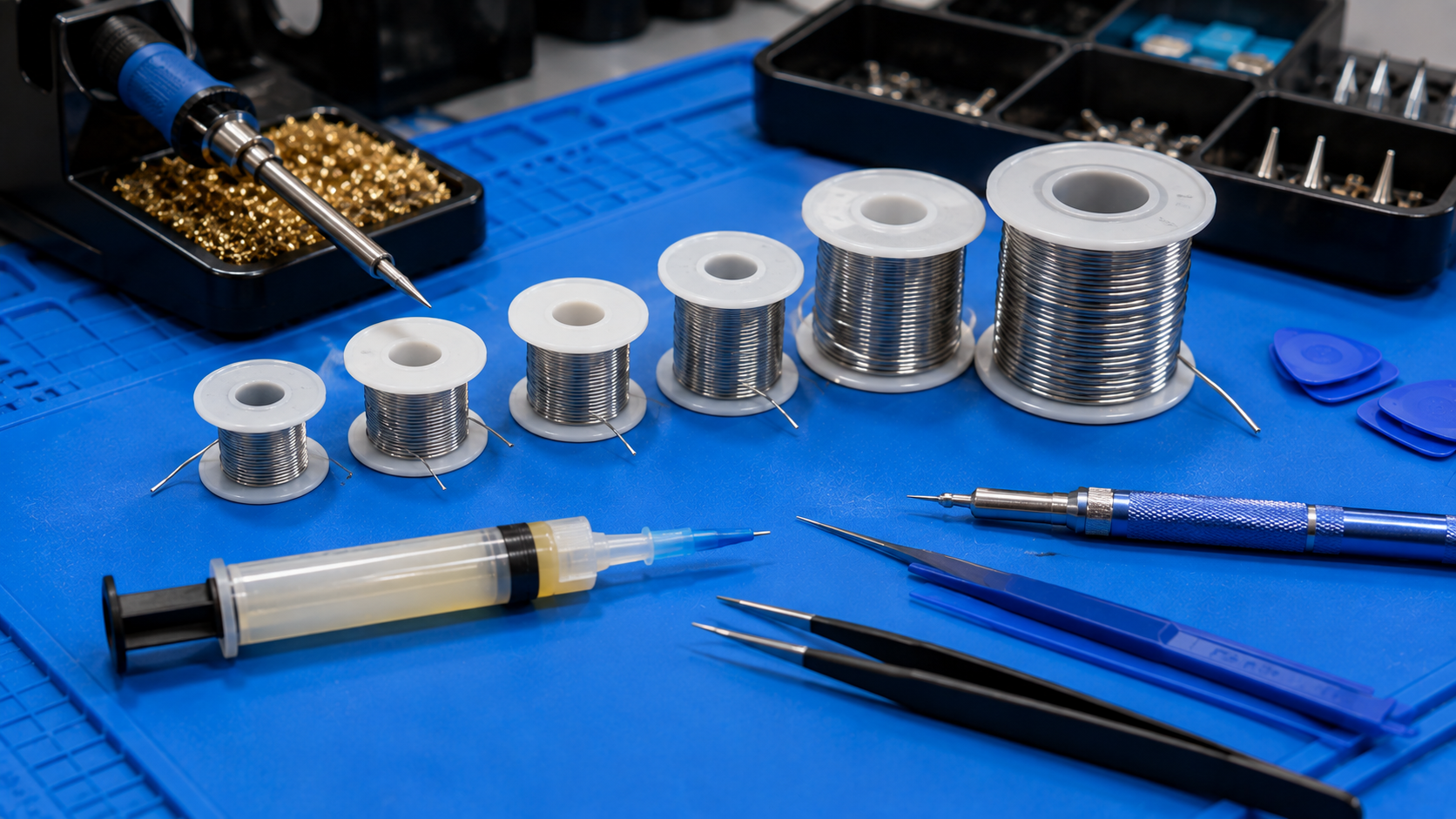
What Solder Should Beginners Use?
If you're just getting started with electronics repair, one of the first questions you'll probably ask is:
"What solder should I buy?"
There are many different solder alloys, wire diameters and formulations available, but for most beginners the choice is much simpler than it first appears.
Using the right solder makes learning easier and helps produce cleaner, stronger solder joints.
Leaded vs Lead-Free
One of the biggest decisions is whether to use leaded or lead-free solder.
Leaded Solder
Traditional 63/37 tin-lead solder (Sn63/Pb37) is widely regarded as the easiest solder for beginners because it:
- Melts at a lower temperature.
- Flows smoothly.
- Produces clean solder joints.
- Changes directly from solid to liquid.
- Is forgiving while learning.
Lead-Free Solder
Lead-free solder is commonly used in modern manufacturing and avoids the use of lead.
However, it:
- Melts at a higher temperature.
- Can be slightly harder for beginners.
- Often requires a hotter soldering iron.
If you're learning electronics repair, many hobbyists find leaded solder easier to practise with where its use is appropriate.
What Diameter Should I Choose?
Solder wire comes in several diameters.
For general electronics work:
- 0.3–0.5mm – Excellent for very small SMD components.
- 0.6mm – A great all-round choice.
- 0.8mm – Ideal for general repairs and larger joints.
- 1.0mm+ – Better suited to larger connectors, cables and high-current work.
For most beginners, 0.6mm or 0.8mm offers the best balance of control and solder flow.
Rosin Core Solder
Most electronics solder contains a rosin flux core.
As the solder melts, the flux helps:
- Remove light oxidation.
- Improve solder flow.
- Produce cleaner joints.
Even when using rosin-core solder, adding extra flux during difficult repairs can often improve the results.
Do I Need Flux?
Yes, especially for repairs.
Flux helps solder bond properly to metal surfaces and makes soldering significantly easier.
If solder refuses to flow or sticks poorly, applying additional flux is often one of the first things to try.
What About Safety?
If you use leaded solder:
- Wash your hands after soldering.
- Avoid eating or drinking while working.
- Work in a well-ventilated area.
- Use a fume extractor where practical.
The main concern during soldering is generally the fumes produced by heated flux rather than the lead itself, so good ventilation is recommended regardless of solder type.
Our Recommendation
For someone learning electronics repair, we generally recommend:
- 63/37 rosin-core solder
- Around 0.6mm–0.8mm diameter
- A quality soldering iron
- Additional flux
- Brass wool or a tip cleaner
This combination makes learning considerably easier and helps produce cleaner, more reliable solder joints.
Final Thoughts
Choosing the right solder doesn't have to be complicated.
A good quality 63/37 rosin-core solder in a medium diameter is an excellent starting point for most beginners, while lead-free solder is a good option if you prefer to avoid lead or need to match modern manufacturing requirements.
As your experience grows, you'll naturally find the alloys and wire sizes that best suit the type of repairs you perform.
Frequently Asked Questions
Is 63/37 solder good for beginners?
Yes. Many electronics technicians recommend 63/37 solder because it melts cleanly and is easy to work with.
What size solder should I buy?
For most electronics repairs, 0.6mm or 0.8mm solder is a good all-round choice.
Do beginners need extra flux?
Although rosin-core solder already contains flux, additional flux is extremely helpful for many repairs and can make soldering much easier.